Frequently Asked Questions (FAQ)
Below are some frequently asked questions (FAQ) about the Quality Improvement project and the Research project from members of the community and care team members.
How much supervision or support is required to deliver reminiscence VR in LTC? Are there any trials comparing regular 1:1 reminiscence therapy vs VR?
Each VR reminiscence session is delivered as a 1:1 interaction between the resident and a trained Research Assistant (RA). Sessions are approximately 15–20 minutes of VR exposure within a 1-hour total session. All sessions are screencast to a Smart TV or laptop so that additional staff and caregivers can observe in real time and provide support without requiring additional headsets. Recreation therapists may also be present to support reminiscence delivery.
Key safety points:
- Residents must be seated throughout (to reduce fall risk)
- RA monitors for disorientation, VR-related discomfort, or emotional distress
- Sessions can be paused or stopped at any time
- Risks are considered low and screened at baseline
Regarding RCT Comparisons (VR vs Standard Reminiscence Therapy):
The literature (Sole et al., 2023; Morris et al., 2026) suggests comparable or enhanced engagement outcomes with VR-based and Snoezelen-type sensory approaches, but direct comparative trials are limited. The current VR study is a mixed-methods quasi-experimental feasibility study, not an RCT. This is an acknowledged gap in the evidence base and an area for future research.
What efforts are in place to collect staff workload and feedback?
The following mechanisms are embedded in the Tech-ICP Quality Improvement (QI) design:
Informal focus groups and feedback sessions: structured case reviews and huddles allow teams to flag barriers, troubleshoot, and recognize successes
- Pre/post training surveys: anonymous surveys completed by all participating staff (RN, RPN, PSW, BSO Leads) assess changes in knowledge, confidence, and self-efficacy related to NPS management
- Standardized debrief forms: implementation team facilitates staff debriefs through existing team meetings and huddles; feedback is recorded in aggregate (no names)
- Informal focus groups and feedback sessions: structured case reviews and huddles allow teams to flag barriers, troubleshoot, and recognize successes
Do we have a specialized pharmacy consult that can support with reviewing polypharmacy?
We do not have a universal mechanism or requirement in the Integrated Care Pathway to get pharmacy consultation, however if pharmacist support is available at a given site, we would welcome their input.
Further, the project summary explicitly includes “Pharmacological Streamlining to reduce inappropriate medication use in consultation with pharmacists and physicians” , we will provide education to physicians to streamline medications to reduce polypharmacy, and provide resources as needed.
The availability of a dedicated clinical pharmacist at each LTCH site will vary. If your home does not have regular pharmacist access, this should be raised with the Tech-ICP implementation team so appropriate supports can be arranged (e.g., GMHOT consultation, regional pharmacy resources).
How can long-term care homes establish clear operational ownership of non-pharmacological interventions when clinical teams are already operating at or beyond capacity when it comes to staffing?
We appreciate this challenge, it has been identified in both the Tech-ICP QI design and the supporting literature (Morris et al., 2026). That is why Tech-ICP study has on-site support in the form of an implementation team member who can help with planning and delivery of non-pharmacological interventions in collaboration with the LTCH clinical team. Further down the road, in the interest of sustainability, we will identify a local champion who can continue the work after Tech-ICP, that may be an additional resource that is needed. Further, we believe Tech-ICP will simplify work flows and save time and lower care burden for the clinical teams by providing a clear decision support tool. This process will be integrated into daily care customized to each LTC, not added as separate tasks. Finally, involvement of family members more actively in person’s care may also alleviate some of the burden related to non-pharmacological interventions.
What are the blood markers looked at in the study?
Blood collection is an optional component of the Tech-ICP research study, collected at baseline and 12 months. Samples (~20 mL) are processed by the Clinical Lab for: Plasma (EDTA and citrate tubes) & Serum.
The primary scientific purpose is to examine biomarkers of neurodegeneration and Alzheimer’s pathology, including their association with NPS and change with successful NPS treatment.
How is this an effective study? What is the comparison?
This is an important question about study design. The Tech-ICP is structured as a longitudinal cohort study, not a randomized controlled trial.
Design rationale:
- The main project is a quality improvement (QI) initiative: all residents with NPS in participating homes enter the pathway. No control arm is withheld.
- Effectiveness is evaluated by comparing change in aggregate LTC level indicators that are collected as part of the minimal dataset, and Tech ICP research study will also collect data on within-person change from baseline (Month 0) to follow-up timepoints (Months 1, 2, 3, 6, 12) on outcomes including NPS severity (NPI-Q, CMAI, CGI-S), falls, ED visits, hospitalizations, antipsychotic use, and polypharmacy rates.
- We will compare this with historical data from the same LTCs that is part of the CIHI database.
- Finally, we are also planning to set aside 20 LTCs for a step wedge randomized controlled design in which the time of induction into the ICP (chosen randomly) would allow comparison similar to an RCT but in a pragmatic design, thus allowing a more robust effectiveness evaluation.
Was there a functional criteria used for choosing PwD that qualified for VR?
No specific functional or ADL-based criteria are used to determine eligibility. The decision will be based on clinical team’s judgment as to who can benefit from the VR.
What are the inclusion criteria for residents? Have you tested these assessments in the typical LTC residents?
Inclusion Criteria (Tech-ICP Research Study):
- Aged 50 years or above
- Presence of NPS as reported by clinical care team or GMHOT
- Resident of a unit participating in the Tech-ICP QI project
- Able to consent or have an SDM who can consent
The Tech-ICP uses well-validated, widely used instruments in geriatric and LTC research contexts:
- NPI-Q (Neuropsychiatric Inventory Questionnaire): extensively validated in dementia populations including LTC
- CMAI (Cohen-Mansfield Agitation Inventory): specifically developed and validated in nursing home populations
- MoCA: validated for use in LTC for high functioning individuals; the SCIRS is used as an alternative for residents with very low cognitive scores (MoCA <5), ensuring the assessment suite accommodates the full cognitive spectrum of typical LTC residents
- PAINAD: validated for pain assessment in advanced dementia
- FAST: used to stage dementia severity
The assessment battery has been specifically selected to reflect the typical heterogeneity of LTC populations, including those with advanced dementia.
What will be the cost to implement this technology in LTC?
There is no cost to the LTC, all expenses related to technology will be funded by the Tech-ICP program.
Will there be anything in place for persons with advanced dementia?
This question spans both pharmacological and non-pharmacological categories.
Non-Pharmacological (evidence-informed, within Tech-ICP scope):
- Personalized music therapy, reminiscence therapy, VR reminiscence, structured meaningful engagement
- Sensory approaches: aromatherapy, light therapy (particularly for sundowning), Snoezelen/multi-sensory environments
- Doll therapy, robotic companions (e.g., PARO), exercise programs
- Multimodal person-centred programs combining two or more of the above
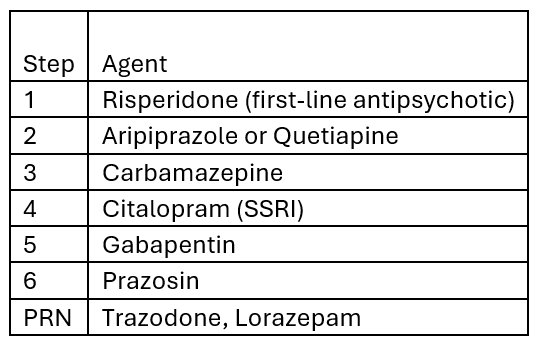
Pharmacological (within the Tech-ICP medication algorithm):
- More recently emerging pharmacological options in the broader literature (not specific to Tech-ICP) include brexpiprazole (FDA-approved 2023 for agitation in Alzheimer’s dementia) and ongoing interest in cannabinoids and dextromethorphan/quinidine combinations, though these are not yet part of the current Tech-ICP algorithm. Disease-modifying agents (e.g., lecanemab, donanemab) target amyloid pathology and are not indicated for BPSD symptom management.
The Tech-ICP uses the CAMH sequential medication algorithm (Davies et al., 2018) as its pharmacological framework. The algorithm is in the process of getting updated to incorporate new treatments.